
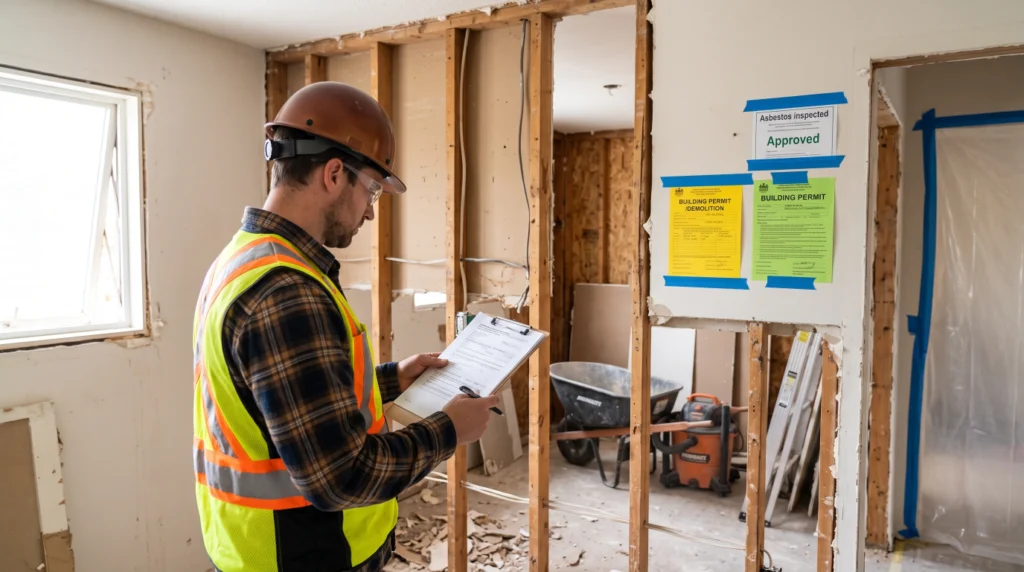
Usually, yes. In Alberta you need a demolition permit to demolish, move or partly demolish a building. Work inside a building often needs a renovation permit instead, and cosmetic work like painting or flooring usually needs none. Your city makes the call, so check before you start.
Last reviewed October 2026 by the Enviro Surface Removers team. Rules change, so confirm details with your city or town.
Do You Need a Demolition Permit? The Short Answer
Often. Do you need a demolition permit? If you are tearing down, moving or partly demolishing a building, yes. If you are only working inside a house or an office, the city may ask for a renovation permit instead. Work that is only cosmetic usually needs no permit.
The name of the permit matters less than the rule behind it. Nobody should start until the city says yes in writing. Alberta cities and towns enforce that through the Safety Codes Act. Each one runs its own forms and steps.
This guide shows which permit fits which job. It covers what Calgary and Edmonton ask for, where asbestos fits in and what happens if you skip the permit. We are a demolition and abatement contractor, not a permit office. For the details, use the city’s own pages.
Permits for Demolition in Alberta at a Glance
- Whole or partial building: a demolition permit, says the City of Calgary
- Work inside a house: usually a building permit for structural changes, such as moving or removing walls
- Cosmetic work: painting, flooring and cabinets usually need no permit, says the City of Edmonton
- Older buildings: an asbestos form or letter is part of the application
- Utilities: gas, water and power are disconnected before demolition
- Who applies: the owner, an authorized representative or the contractor, depending on the city
- Skipping it: can mean a stop-work order, a fine and trouble at resale
- Not a permit: Edmonton’s asbestos form says on its face that it is not a permit
Demolition Permit, Building Permit or Trade Permit: Which Does Your Job Need?
Alberta cities use different permits for different work. Use this table as a starting point, then check with your city.
| Your job | Permit usually asked for | What to know |
|---|---|---|
| Demolish or move a building, or demolish part of it | Demolition permit | Calgary also counts reducing a building to its foundation and rebuilding. |
| Remove or move walls in a house | Building permit (residential improvement) | Calgary lists moving or removing walls on any floor as a structural change. Engineering may be required. |
| Strip out a commercial space | Commercial improvement building permit | Calgary asks for drawings, and an asbestos abatement form is part of the checklist. |
| Change electrical, plumbing or gas | Trade permits | In Calgary, a homeowner can get a trade permit only for their own home. They must live there and do the work themselves. |
| Replace flooring, paint, install cabinets | Usually none | Edmonton lists these as maintenance or minor cosmetic upgrades. |
Need help with a wall in particular? Read our guide on removing an interior wall.
What Counts as Demolition? A Permit to Demolish Versus Cosmetic Work
A permit to demolish covers more than knocking a building down. Calgary says a permit applies when you demolish or move a building. It also applies to partial demolition, or to reducing a building to its foundation and rebuilding. Interior work in an existing house falls under an improvement permit instead.
Cosmetic work sits at the other end. Edmonton says permits are not required for minor cosmetic upgrades. Its examples are replacing flooring, painting and installing kitchen cabinets. Calgary says minor cosmetic work typically needs no permit either.
The middle is where people get caught. Taking out a wall, opening a floor or stripping a room back to the studs is not cosmetic. If the work touches structure, plumbing, electrical or gas, assume you need a permit and ask. A LawNow article on Alberta home improvements gives the same advice. Assume you need a permit until the city tells you otherwise. See the LawNow article on DIY home improvements.
Calgary Demolition Permit: How It Works
A Calgary application starts on the City of Calgary’s demolition page. The City says the owner or an authorized representative can apply, and a hired contractor can apply too. You apply online with a myID account or in person at the Planning Services Centre. See the City of Calgary demolition permit page.
What Calgary asks for
- Utility disconnection forms with signatures for water, electrical and gas
- A site plan showing property lines and the buildings to be demolished
- A public tree disclosure statement, plus a tree protection plan if a public tree is within six metres
- The asbestos abatement form for houses built before 1990
- A heritage review, which applies to all demolition applications
Timing
The City lists about seven days for review and says it is not guaranteed. A permit expires 180 days after it is issued, and you can extend it. If the City asks for more information and gets none within 90 days, it can refuse the application.
For interior work in a house, Calgary points you to the building permit side. The City says a building permit is needed for structural changes, such as moving or removing walls on any floor. Engineering may be required. See the City of Calgary home renovation page.
Edmonton Demolition Permit: How It Works
An Edmonton application follows a similar path, with two pieces worth knowing early: the asbestos form and the gas line. For renovations, Edmonton says permits are required for structural changes, and construction must not start without written permission. See the City of Edmonton renovation permit page.
The asbestos form
Edmonton’s Asbestos Abatement and Utilities Disconnect form covers demolition and renovation applications for houses, row houses, garages and commercial buildings. For a renovation, the asbestos survey may be limited to the areas the work affects. A building from after 1990 can declare that it has no asbestos-containing materials that could release fibres. Read the City of Edmonton asbestos form.
The gas line
For a demolition, Edmonton asks for confirmation that gas lines are cut back. If they are not, the permit is delayed. Contact the gas utility early, because arranging a cutback takes time.
Permit to Demolish Elsewhere in Alberta
The Safety Codes Act sets the rules for safe building across Alberta, and cities and towns run them. That means every town and county has its own forms, fees and lead times. Many publish a demolition application package of their own. Check with your city or town before you plan a date.
The Asbestos Step Almost Every Older Job Hits
If the building is from before 1990, expect asbestos paperwork. Calgary asks for its asbestos abatement form on houses built before 1990. Edmonton’s form accepts a consultant’s clearance letter. It also accepts a completion letter, which confirms that any required work is done under the notice filed with Alberta OHS. A material exemption with photos is the third option. See the City of Calgary asbestos abatement form.
Alberta has its own rules on top of the city’s. Alberta’s OHS Code, section 34, covers asbestos. Building materials that could release fibres must be removed before a building is demolished. An employer must tell Alberta OHS 72 hours before work that may release fibres. The Alberta Asbestos Abatement Manual sets out safe-work steps.
The paperwork starts with a sample. An independent consultant takes it, and a lab reads it. We explain how in our guide to asbestos testing. If you are not sure what an older material is, start with what asbestos looks like. If you are opening a wall, read about asbestos in drywall.
Utilities, Trees, Heritage and Site Signs
A few items catch owners late in the process. Calgary asks you to identify which utilities need disconnecting and to get signatures before you apply. Edmonton wants all service lines terminated, decommissioned or removed as needed. Trees, heritage review and a contact sign on the site can apply too. Handle these before you book a crew.
Who Can Apply: Owner, Representative or Contractor
In Calgary, the owner or an authorized representative can apply. A hired contractor can apply too. Homeowner permits for electrical and plumbing are narrower. Calgary allows them only if you own the home, live in it and do the work yourself.
Edmonton and other Alberta cities set their own rules. Ask your city who may apply before you sign a contract. Then you know who is responsible for the permit and the inspections.
What Happens If You Skip the Permit
Edmonton says that starting without written permission can lead to stop-work orders, fines or penalties. The LawNow article adds that an inspector or court may order you to stop work. You may also have to remove the finished work or pay a penalty. It also warns that you may get less for your house, or be unable to sell it.
Skipping asbestos steps is a separate problem. Disturbing asbestos without a plan puts fibres in the air and can break the OHS rules for the contractor. A permit does not cover that. The OHS notice does.
How to Get Your Permit in Seven Steps
This is the general order. Your city’s page is the final word.
1. Name the job
Decide whether the work is a demolition of a building, a renovation inside it or cosmetic only. That tells you which permit to ask about.
2. Check the building’s age
If it dates from before 1990, plan for asbestos paperwork from the start.
3. Get the asbestos answer
An independent consultant samples suspect materials and a lab reports. Keep the letter for your application.
4. Arrange the utility disconnects
Contact the gas, water and power providers early, because signatures and cutbacks take time.
5. Gather plans and forms
Collect the site plan, drawings where the city asks for them and the asbestos form or letter.
6. Apply and answer the city quickly
Submit the application, then reply to any request for more information right away.
7. Wait for the permit, then book inspections
Do not start until the permit is issued. Book the inspections the city requires as the work moves along.
Where Enviro Surface Removers Fits In
We do the demolition and the asbestos abatement. We are not a permit office and we do not test our own work. The independent consultant tests before the job and clears the area when it is done. We can supply our abatement paperwork for the asbestos part of your application.
Our crew takes an asbestos abatement course every couple of years to stay certified. We seal the work area and poly off rooms that are not being worked on. Our tools have dust shrouds connected to HEPA vacuums, so the work is Virtually Dust-Free. See our interior demolition services, or the asbestos removal and abatement page for the full process.
Demolition Permit in Alberta: Common Questions
Do I need a demolition permit?
If you are demolishing, moving or partly demolishing a building, yes. Calgary says so on its demolition page. For work inside a house, the city may ask for a renovation permit instead. Cosmetic work usually needs none. Your city decides.
Do you need a building permit for demolition?
For the building itself, the city asks for a demolition permit. For interior work, Calgary says a residential or commercial improvement building permit applies. Which one depends on the scope, so check with your city before you plan.
Do you need a permit for demolition inside a house?
Often, if the work changes structure. Calgary lists moving or removing walls on any floor as a structural change that needs a building permit. Edmonton lists structural changes too. Ask your city if the job touches walls, floors, plumbing or wiring.
Does removing a non-load-bearing wall need a permit?
Calgary does not use the term load-bearing. It says moving or removing walls on any floor needs a building permit, and engineering may be required. Ask your city before any cutting. See our guide on interior wall demolition.
Do I need a permit to replace flooring or paint?
Usually not. Edmonton lists replacing flooring, painting and installing kitchen cabinets as minor cosmetic upgrades that do not need a permit. Calgary says minor cosmetic work typically needs none. Check first if the work goes deeper.
Who can apply for a permit to demolish?
In Calgary, the owner or an authorized representative can apply. A hired contractor can too. Other cities and towns set their own rules, so ask who may apply before you sign a contract.
How long is a permit good for?
In Calgary, a permit expires 180 days after it is issued. You can extend it. Other cities differ. Ask yours before you plan the schedule.
Do I need the asbestos form?
In Calgary, the asbestos abatement form is for houses built before 1990. In Edmonton, the form applies to demolition and renovation applications. A building from after 1990 can declare that it has no asbestos-containing materials.
What proof of asbestos does Edmonton accept?
Edmonton’s form accepts a consultant’s clearance letter or a completion letter. It also accepts a consultant’s abatement plan, or a material exemption with photos. The form itself says it is not a permit.
Do I have to disconnect utilities first?
Yes, for a demolition. Calgary asks for signatures on the utility disconnection forms before you apply. Edmonton asks for gas line cutback confirmation, and the permit is delayed without it.
What happens if I demolish without a permit?
Edmonton warns of stop-work orders, fines and penalties. A LawNow article adds that you may have to remove the work, and that it can hurt resale. Asbestos rules apply on top of any permit.
Does the permit cover the asbestos work?
No. Asbestos is handled under Alberta OHS rules. An employer must tell OHS 72 hours before work that may release fibres. The city asks for asbestos paperwork with the application.
How much does a demolition permit cost?
Fees vary by city, and by the size and type of the job. Calgary points applicants to a building permit fee calculator for demolition. Check your own city’s fee page before you apply.
Do other Alberta towns require a permit to demolish?
Yes. The Safety Codes Act sets the framework, and cities and towns run it. Many publish their own demolition application packages. Check with your town or county before you start.